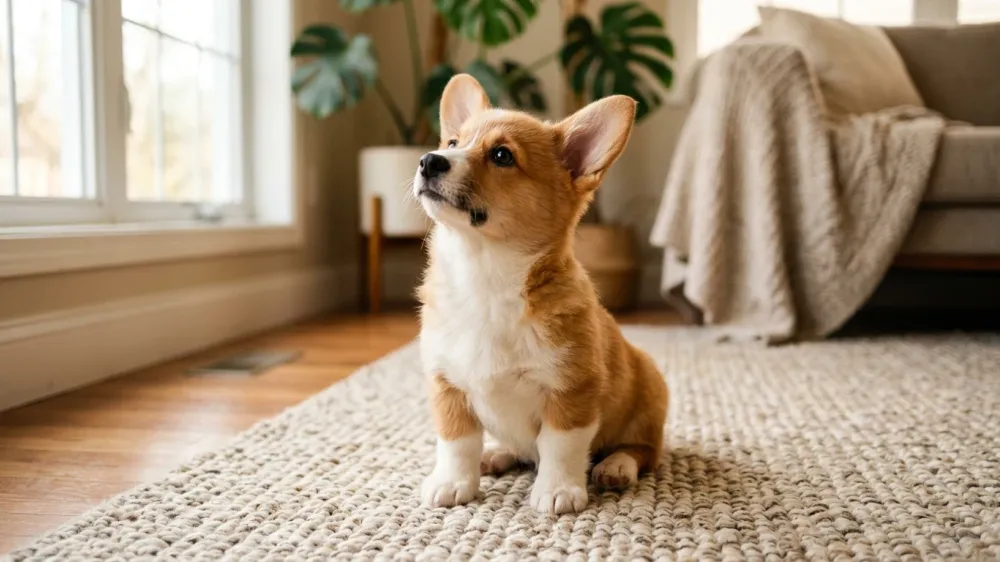
Teaching a puppy to sit is the cornerstone of all dog obedience. It provides a reliable default behavior that prevents unwanted actions like jumping, begging, or bolting through doors. A reliable sit command creates a focused mindset in your dog, making it easier to progress to advanced skills such as recall training or learning the impulse control. Success requires consistency, high-value rewards, and an understanding of how dogs learn through physical markers.
📋 In This Guide
Prepare Your Training Environment#
Before starting, make sure your puppy is in a state conducive to learning. Training a puppy immediately after a nap or right before a meal is often counterproductive. A slightly hungry, well-exercised puppy has the highest focus level. Choose a quiet area with minimal distractions, such as a carpeted hallway or a fenced-in yard. If you are currently working on potty training, make sure the puppy has recently had a bathroom break to avoid interruptions.
Equip yourself with small, pea-sized treats that can be consumed instantly. Large or crunchy treats take too long to eat and break the flow of the session. We recommend using
Zuke's Mini Naturals Training Treats
These small, low-calorie treats are the industry standard for positive reinforcement, allowing for the high frequency of rewards necessary during puppy training sessions.
because their soft texture and high-protein scent keep puppies engaged through multiple repetitions without causing gastrointestinal upset or excessive calorie intake.
💡 Pro Tip: Use a ‘marker’ word like ‘Yes!’ or a clicker the exact millisecond your puppy’s bottom touches the ground. This marks the precise behavior you are rewarding, helping the dog make the mental connection faster.
Phase 1: The Luring Technique#
Luring is the most effective way to communicate what you want without using physical force. Never push your puppy’s hindquarters down, as this often triggers an ‘opposition reflex,’ causing them to push back against your hand.
- Position the Lure: Hold a treat between your thumb and forefinger. Place your hand directly in front of the puppy’s nose so they can smell it but not grab it.
- The Upward Arc: Slowly move your hand back over the puppy’s head toward their tail. Keep your hand close to their muzzle. As their head goes up to follow the treat, their center of gravity will naturally shift, and their bottom will drop.
- Mark the Behavior: The moment their rear end contacts the floor, say your marker word (‘Yes!’) or click.
- Deliver the Reward: Give the puppy the treat immediately after the marker.
- Reset: Take a step back to encourage the puppy to stand up, then repeat the process.
Phase 2: Introducing the Verbal Cue#
A common mistake is saying ‘Sit’ repeatedly before the puppy knows what it means. Only add the verbal cue once the puppy is reliably following the hand lure 90% of the time. Dogs are visual learners, so they pick up on hand movements much faster than human language.
To transition, say the word ‘Sit’ clearly and firmly (not as a question), wait one second, and then use the hand lure to guide them into position. Over 15 to 20 repetitions, the puppy will begin to anticipate the lure and sit as soon as they hear the word. Once they are sitting on the verbal cue alone, you can fade the hand lure by using an empty hand as a signal and rewarding from your pocket or a treat pouch instead.
Phase 3: Mastering the 3 Ds#
A puppy that sits in the living room might fail to sit at the park. To build a reliable ‘Sit’ command, you must train through the three pillars of reliability: Distance, Duration, and Distraction.
Distance#
Gradually increase the space between you and your puppy. Start with a single step back, ask for the sit, and return to reward them. If they break position to follow you, the distance was too great. Reduce the distance and try again.
Duration#
Teach the puppy that ‘Sit’ means ‘Stay in a sit until released.’ Use a release word like ‘Free’ or ‘Okay.’ Start by asking for a sit and waiting two seconds before marking and rewarding. Slowly increase this to five, ten, and thirty seconds. If you are working on crate training overnight, practicing sit-stays at the crate door is an excellent way to build impulse control.
Distraction#
Introduce controlled distractions, such as a bouncing ball, another person walking by, or the sound of a doorbell. This is where you might need to revert to using a lure or higher-value treats to maintain focus. If the puppy cannot perform the task, move further away from the distraction until they are successful.
Troubleshooting Common Training Mistakes#
Training is rarely a linear process. If your puppy struggles, refer to this troubleshooting guide to identify the issue.
| Issue | Probable Cause | Action Plan |
|---|---|---|
| Puppy jumps up | Treat is held too high | Keep the lure closer to the nose; move it backward, not upward. |
| Puppy backs away | Lure is moving too fast | Move your hand more slowly and keep it within an inch of the muzzle. |
| Puppy loses interest | Session is too long | Keep training sessions under 5 minutes. Puppies have short attention spans. |
| Puppy ignores the cue | Too many distractions | Move to a quieter room and re-establish the behavior before adding noise. |
Puppy Training FAQ#
At what age should I start teaching my puppy to sit?#
You can begin basic luring as early as 8 weeks old. Puppies are like sponges at this age and can learn simple commands very quickly, provided the sessions are kept positive and short.
Should I use a leash while teaching sit?#
Using a leash is helpful when you move training outdoors. It prevents the puppy from wandering off if they get distracted. However, never use the leash to ‘pop’ or pull the puppy into a sitting position. For outdoor sessions, use a comfortable setup; see our guide on harness vs collar for puppies.
What if my puppy refuses to sit on certain surfaces?#
Many puppies find cold tile or wet grass uncomfortable. If your puppy sits on carpet but refuses on hardwood, they may be slipping or find the surface aversive. Practice on various surfaces gradually to help them generalize the behavior.
Summary: 5-Step Action Plan for Success#
To help your puppy master the sit command, follow this structured weekly timeline:
- Days 1-2: Focus exclusively on the lure. Do 3 sessions a day, 5 minutes each. No verbal cues yet.
- Days 3-4: Introduce the word ‘Sit’ one second before the lure. Mark and reward every success.
- Days 5-7: Use the verbal cue and wait for the puppy to offer the behavior. Fade the treat lure but keep the hand signal.
- Week 2: Practice the sit in every room of the house and in the front yard. Introduce a 3-second duration.
- Week 3: Introduce low-level distractions. Reward heavily for focus in difficult environments.
Consistency is the single most important factor in dog training. Make sure every family member uses the same word and the same hand signal to avoid confusing the puppy. With patience and positive reinforcement, your puppy will soon offer a sit as their default way of asking for attention, food, or play.
💡 Related Guide: Once sit is solid at home, practice it in new places; see how to socialize a puppy before vaccines.