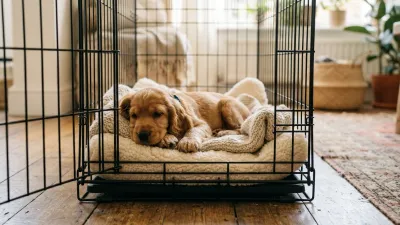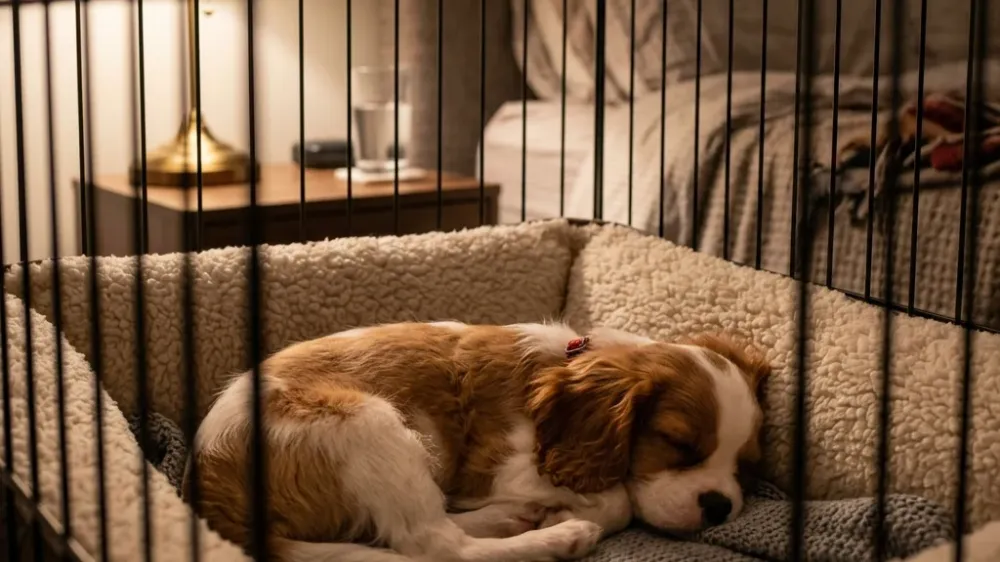
Getting a puppy to sleep quietly in their crate on night one requires a combination of physical tire-out, strategic crate placement, and consistent nighttime boundaries. Young puppies experience a sudden disruption when moving from their littermates to a new environment, making the first few nights critical for establishing calm sleeping habits. By following an intentional evening routine and managing crate conditions, you can establish a quiet nighttime schedule right from day one.
📋 In This Guide
Preparing the Crate for Nighttime Success#
A puppy crate should function as a secure, cozy den rather than an isolated penalty zone. Proper crate sizing and placement directly impact how quickly your puppy settles down when the lights go out.
Crate Sizing and Divider Setup#
The crate must be sized appropriately for your puppy’s current weight. If the crate is too large, your puppy may sleep in one corner and eliminate in another. Use a crate divider panel to restrict the space so the puppy has just enough room to stand up, turn around completely, and lie down comfortably with legs extended. As your puppy grows, adjust the divider to expand the interior footprint.
Strategic Crate Placement#
For the first several nights, place the crate in your bedroom directly next to your bed. Being able to hear your breathing and smell your presence comforts a young puppy who has just left their mother and littermates. Keeping the crate at eye level on a nightstand or directly beside your mattress allows you to lower a hand to soothe them without removing them from the enclosure. Once your puppy sleeps through the night consistently, you can gradually shift the crate to its permanent location over several days if desired. For daytime crate practice, see the steps in our guide on how to stop puppy barking at night and in the crate.
💡 Pro Tip: Keep a lightweight blanket or sheet draped over three sides of the wire crate to block visual distractions and create a cozy, cave-like environment. Leave the side facing your bed exposed so your puppy can see you.
Comfort and Calming Aids#
Avoid placing plush, easily shredded beds inside the crate during the first week if your puppy is actively chewing or prone to accidents. Instead, use a flat, washable fleece mat or towel. To replicate the thermal warmth and companion feel of littermates, introduce targeted soothing tools designed specifically for young dogs during transitional periods.
SmartPetLove Snuggle Puppy Heartbeat Plush Toy
A soothing plush toy equipped with a simulated heartbeat and heat pack that helps comfort young puppies and reduces nighttime crate whining.
The Step-by-Step Evening Schedule for Night One#
Structuring the final three hours before bedtime prevents late-night energy spikes and minimizes midnight potty emergencies.
| Time Window | Action Required | Training Focus |
|---|---|---|
| 3 Hours Before Bed | Cut off food access | Prevents late-night digestion and emergency bowel movements |
| 2 Hours Before Bed | Engage in physical play and mental games | Exhausts excess physical and mental energy |
| 1 Hour Before Bed | Cut off water access | Reduces bladder pressure during overnight sleeping hours |
| 30 Mins Before Bed | Calm wind-down phase | Lowers heart rate with gentle petting and light chewing |
| 15 Mins Before Bed | Final outdoor potty trip | Helps empty bladder right before crate entry |
| Bedtime | Direct crate entry with reward | Establishes positive association with nighttime shutdown |
Step 1: Manage Food and Water Intake#
Withhold food three hours prior to bedtime, and pick up water bowls one to two hours before sleeping. Young puppies have miniature bladders and rapid digestive systems. Restricting late evening intake helps that your puppy is not battling a full bladder or active digestive tract during key rest hours. Combine this schedule with an effective potty training routine during daytime hours.
Step 2: Implement Physical and Mental Tire-Out#
Engage your puppy in physical play and short, positive mental exercises roughly two hours before bedtime. Mental stimulation burns energy even faster than physical exercise. Short basic obedience sessions, gentle tug-of-war, or sniffing games exhaust young minds effectively. Avoid high-arousal games within the final hour before sleep to allow their nervous system to settle.
Step 3: The Pre-Bed Wind-Down Phase#
Dim the lights and lower the volume in your home during the final 30 to 40 minutes before bed. Swap active toys for a safe rubber chew toy. Chewing releases endorphins in a dog’s brain, naturally inducing relaxation and drowsiness.
Step 4: Final Potty Trip#
Immediately before leading your puppy into the crate, take them outside to their designated potty spot on a leash. Give them up to 5 or 10 minutes to relieve themselves. Praise quietly when they eliminate, but keep the interaction calm and businesslike to avoid re-energizing them.
Handling Nighttime Whining and Crying#
One of the greatest challenges dog owners face overnight is determining whether a crying puppy needs to eliminate or is simply protesting confinement.
⚠️ Safety Warning: Never use the crate as a form of punishment or force a frantic puppy into a crate while yelling. Pushing a puppy beyond their stress threshold creates long-term negative associations that can lead to severe issues like puppy separation anxiety.
Deciphering the Cry: Demand Crying vs. Potty Need#
- Demand Crying: Often starts immediately after putting the puppy in the crate. It involves high-pitched yapping, pacing, or pawing at the door while energy levels remain high.
- Potty Warning Crying: Usually happens after a period of quiet sleep. If your puppy slept for two hours and suddenly wakes up whining, whimpering, or scratching, their bladder is likely full.
How to Respond Without Reinforcing Bad Behaviors#
If the puppy exhibits demand crying right after bedtime:
- Wait out initial protest vocalizations without making eye contact, talking, or letting them out. Responding to demand barking teaches the puppy that noise opens the crate door.
- If whining persists beyond a few minutes, gently place your hand against the crate door so the puppy smells you. Keep your voice quiet and say a single calming phrase like “settle.”
- Avoid opening the crate door until the puppy offers at least 5 to 10 seconds of complete silence.
Managing Overnight Potty Breaks#
At 8 to 12 weeks of age, most puppies cannot hold their bladders for an eight-hour stretch. A general rule of thumb is that a puppy can comfortably hold their bladder for their age in months plus one hour (e.g., a 2-month-old puppy can hold it for roughly 3 hours overnight).
The “Boring” Potty Break Method#
When your puppy wakes you in the middle of the night for a potty break, handle the trip with zero entertainment value:
- Keep room lights dim or use a soft nightlight.
- Pick up the puppy, clip on their leash, and carry them directly to the outdoor potty spot to avoid accidents en route.
- Use your potty cue word once and wait silently for 3 to 5 minutes.
- Do not play, talk excessively, or offer treat rewards during nighttime breaks.
- Once the puppy eliminates, carry them back indoors immediately, place them into the crate, close the door, and return to bed.
By keeping nighttime breaks strictly business, your puppy learns that waking up at night yields no play or social interaction, encouraging them to go back to sleep quickly.
Search Intent FAQ: Quick Nighttime Solutions#
Should I keep the crate in my bedroom on night one?#
Yes. Placing the crate in your bedroom near your bed for the first several nights significantly reduces fear and anxiety. Young puppies instinctively fear being isolated from their pack. Hearing your breathing and having you nearby provides emotional security, allowing them to settle faster.
What should I do if my puppy cries continuously for over 30 minutes?#
Continuous, panicked crying that escalates into frantic digging or distress indicates the puppy is overwhelmed. Check if they need a potty break first. If their bladder is empty, bring the crate closer to your bed, rest your hand on the wire mesh, and speak softly. If distress continues, evaluate whether the puppy is in physical discomfort or cold. Never leave a puppy in a state of severe panic, as this creates lasting anxiety around crate confinement.
How many times will an 8-week-old puppy wake up at night?#
An 8-week-old puppy typically requires one to two scheduled or requested potty breaks per night. As bladder control develops, most puppies can sleep through a full 7 to 8 hour stretch between 12 and 16 weeks of age.
Summary: Your Nighttime Crate Training Action Plan#
Successfully crate training a puppy overnight relies on clear management, consistent evening routines, and structured responses to nighttime vocalizations.
- Set up the crate beside your bed with a divider panel and warm soothing aids.
- Cut off food 3 hours prior and water 1 hour prior to sleep.
- Run a wind-down routine with physical play, mental enrichment, and a quiet outdoor potty trip.
- Keep midnight potty breaks brief and neutral, avoiding any play or social stimulation.
- Ignore demand crying while providing calm proximity comfort for legitimate distress.
Following this structured plan establishes reliable sleep patterns, prevents housebreaking setbacks, and helps your puppy adjust comfortably to nighttime crate sleeping from night one.
💡 Related Guide: White noise and comfort toys help some puppies settle. See our picks for the best puppy calming aids for night.
💡 Related Guide: Rapid respirations or twitching during REM sleep can worry new owners; learn why is my puppy breathing fast while sleeping to distinguish dreams from respiratory distress.