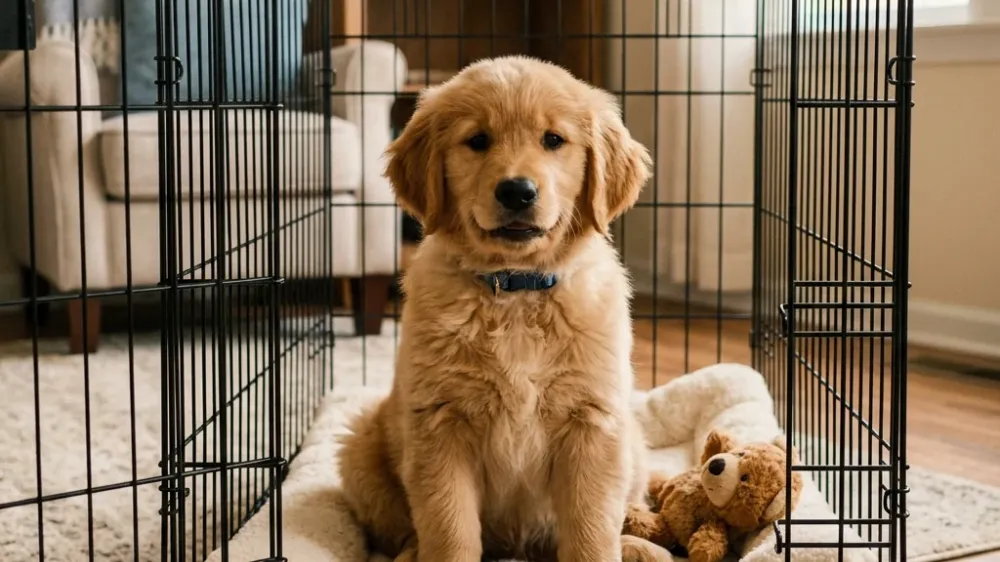
Picking the right size crate is one of the bigger gear decisions you will make for a young dog. A properly sized crate works as a safe den, helps with house training, and gives your puppy a secure resting spot. Choosing a crate that is too small restricts natural movement and causes discomfort, while picking one that is too large encourages puppies to sleep on one side and eliminate on the other.
Size a puppy crate around a simple rule: your dog must be able to stand up without slouching, turn around fully without hitting the sides, and lie down stretched out on their side comfortably.
📋 In This Guide
The Goldilocks Rule: Exact Space Requirements#
To understand crate sizing, you must look at how puppies use their sleeping spaces. Dogs naturally avoid soiling the spot where they sleep. When a crate gives just enough room to sleep, sit, stand, and turn, your puppy has a natural reason to hold it until the next potty break.
If you place an eight-week-old Golden Retriever puppy into an extra-large adult crate without modifications, they will inevitably use one end as a bed and the far corner as a bathroom. Conversely, if the crate is too tight, your puppy will press against the wire frames, leading to anxiety and potential physical strain.
Core Sizing Standards#
- Height: The top of the crate should sit 2 to 4 inches above the tip of your puppy’s ears or head when standing erect.
- Length: The crate length should measure 2 to 4 inches longer than your puppy from the tip of their nose to the base of their tail.
- Width: The interior width should allow your puppy to lie flat on their side with legs outstretched without being pressed against the walls.
Step-by-Step: How to Measure Your Puppy#
Measuring a squirming puppy requires patience and simple tools. Have a soft tape measure and a handful of small training treats ready before starting.
- Measure Standing Height: Position your puppy against a wall in a natural standing stance. Measure straight up from the floor to the highest point of their head. If your puppy has erect ears (like a German Shepherd or French Bulldog), measure to the top tip of their ears.
- Measure Body Length: Place the start of the tape measure at the tip of your puppy’s nose and run it along their spine to the base of the tail where it joins the body. Do not include the length of the full tail.
- Calculate Minimum Crate Dimensions: Add 2 to 4 inches to both your height and length measurements. This total gives you the target internal measurements for your puppy’s immediate size.
💡 Pro Tip: If your puppy is currently between standard crate sizes, always choose the larger size and install an adjustable divider panel to restrict the usable interior area.
Sizing for Growth: The Divider Panel Strategy#
Buying a new crate every two months during a puppy’s rapid growth phase is expensive and unnecessary. We recommend buying a crate sized for your puppy’s predicted adult weight and using a divider panel during puppyhood.
A divider panel hooks securely onto the side wires of a metal crate, allowing you to manually adjust the length of the interior space as your dog grows. You start by setting the panel so the puppy has just enough room to lie down and turn around. Every few weeks, simply unhook the panel and move it back a few inches to accommodate their growth.
How to Predict Adult Size#
To buy the correct adult-sized crate from day one, review the standard adult dimensions for your breed:
- Small Breeds (Toy Poodle, Chihuahua): 18 to 24-inch crate length
- Medium Breeds (Beagle, Cocker Spaniel): 30 to 36-inch crate length
- Large Breeds (Labrador, Golden Retriever): 42-inch crate length
- Extra Large Breeds (Great Dane, Mastiff): 48 to 54-inch crate length
For mixed-breed puppies, consult your shelter or veterinarian for growth estimates based on paw size and parentage history.
Quick Reference Crate Sizing Chart#
Use this standard chart to match your dog’s current or projected adult measurements to the correct crate dimensions:
| Crate Length | Ideal Dog Weight | Target Dog Height | Common Example Breeds |
|---|---|---|---|
| 18“ to 22“ | Under 10 lbs | Up to 12“ | Chihuahua, Pomeranian, Yorkie |
| 24“ | 11 - 25 lbs | Up to 17“ | Dachshund, Pug, Boston Terrier |
| 30“ | 26 - 40 lbs | Up to 20“ | Beagle, French Bulldog, Corgi |
| 36“ | 41 - 70 lbs | Up to 24“ | Border Collie, Bulldog, Aussie |
| 42“ | 71 - 90 lbs | Up to 29“ | Labrador, Golden Retriever, Boxer |
| 48“+ | Over 90 lbs | 30“+ | German Shepherd, Mastiff, Dane |
Choosing the Right Style for Sizing Flexibility#
Not all crates offer the same sizing options or interior modifications. Consider these structural differences before selecting your model:
Wire Crates#
Wire crates offer the highest degree of sizing flexibility. They almost always include divider panels, feature excellent ventilation, and allow easy visibility. They are the ideal choice for home housebreaking and general crate training.
Heavy Plastic Crates (Airline Approved)#
Plastic shell crates offer a secure, dark environment that can soothe anxious dogs. However, they rarely accommodate internal divider panels. If you prefer plastic, plan on buying a bigger crate or two as your puppy grows.
Soft-Sided Crates#
Soft crates are light and convenient for travel, but they cannot be resized with dividers. Additionally, destructive puppies can easily chew through mesh doors and nylon seams. Save soft-sided options for fully crate-trained adult dogs.
⚠️ Safety Warning: Never place a puppy inside an oversized soft crate or plastic shell with loose blankets intended to fill empty space. Puppies can burrow under excessive bedding, creating suffocation risks or ingestion hazards.
Integrating Crate Sizing into Daily Training#
The right crate size makes the rest of crate training easier. Getting the interior dimensions right helps prevent restless pacing and whining at night. Once the crate is set up, our guide to crate training a puppy overnight covers building positive crate associations and getting through the first nights home.
If your puppy is vocalizing despite having the proper dimensions and comfort, check for other environmental triggers using our strategy to stop puppy barking at night. A well-sized crate can also make things a little easier for puppies dealing with separation anxiety.
For walks between crate sessions, our guide to choosing a harness or collar for your puppy covers fit and safety.
💡 Related Guide: Need more room than a crate during the day? See our guide to indoor puppy playpens.
Frequently Asked Questions#
Should I buy a crate based on my puppy’s current size or adult size?#
Buy a crate based on your puppy’s expected adult size, provided the crate comes with an adjustable divider panel. This allows you to restrict the interior space to match your puppy’s current length and height, expanding the floor space as they grow without needing multiple crates.
How do I know if my puppy’s crate is too big?#
Your crate is too big if your puppy consistently sleeps at one end and uses the opposite corner as a bathroom site. If you notice your puppy eliminating inside the crate despite regular bathroom breaks, move the divider panel closer to reduce excess floor space.
Can a puppy crate be too high?#
Crate height is rarely a problem on its own, provided the length and width are restricted properly. However, if a crate is excessively tall relative to its floor space, some puppies may feel less secure. Make sure the overall proportions match standard wire crate dimensions.
MidWest iCrate with Divider Panel
A popular wire crate that comes with a divider panel, allowing you to buy the adult size and adjust the interior space as your puppy grows.
Summary: Checklist for Selecting the Ideal Crate Size#
Follow this final action plan before making your crate purchase:
- Take Accurate Baseline Measurements: Measure your puppy’s standing height (floor to head/ears) and nose-to-tail length.
- Add Clearance Allowances: Add 2 to 4 inches to both height and length for immediate fit.
- Estimate Adult Size: Research breed standards or ask your shelter team for projected full-grown weights.
- Select a Wire Crate with a Divider: Buy for adult length and install the divider panel immediately at the smallest setting.
- Test the Fit: Verify your puppy can sit upright, stand comfortably, turn around 360 degrees, and lie flat on their side.
- Adjust Monthly: Move the divider panel back as your puppy gains weight and height throughout development.