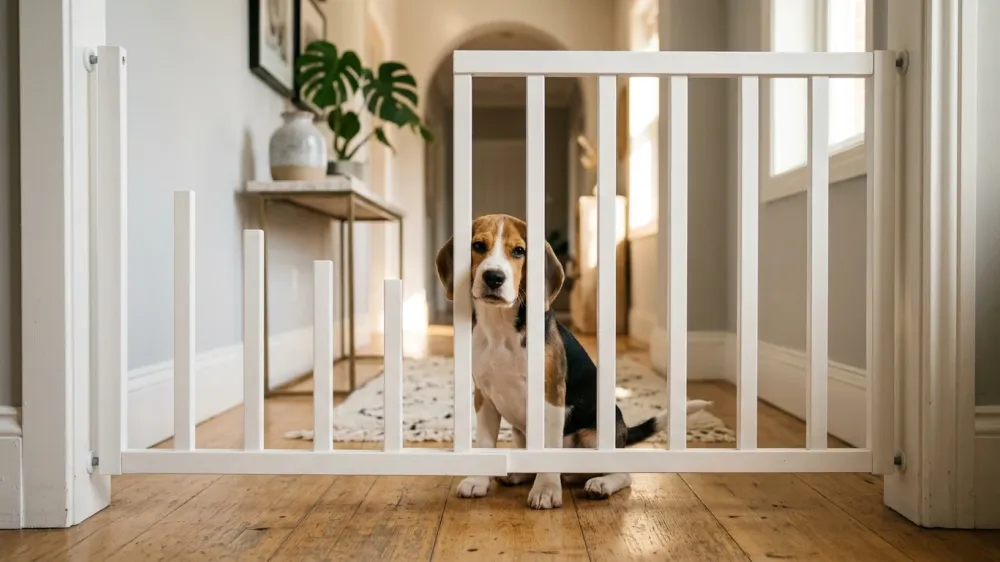
Controlling access to stairs, kitchens, and carpeted rooms is the foundation of a successful housebreaking and safety strategy. When you bring a new puppy home, you quickly realize that they are curious explorers with very little impulse control. High-quality gates and barriers allow you to manage their environment, prevent destructive chewing, and keep them away from household hazards. Think of gates not just as physical barriers, but as key tools for teaching boundaries and establishing a routine.
Effective management reduces the number of mistakes a puppy can make. If a puppy cannot reach the sofa, they cannot chew the sofa. If they are restricted to a tiled kitchen, housebreaking accidents are much easier to clean and manage. Combining gates with other tools like puppy playpens for indoor use creates a multi-layered safety net that keeps your home intact while your puppy learns the rules.
📋 In This Guide
Types of Puppy Gates and Barriers#
Selecting the right gate depends on the layout of your home and the tenacity of your puppy. Not all barriers are created equal, and choosing the wrong type can lead to wall damage or, worse, a collapsed gate that could injure a small dog.
Pressure-Mounted Gates#
These are the most common barriers for indoor use. They stay in place by applying pressure against the doorframe or walls. They are excellent for temporary setups and do not require drilling into your woodwork. However, they are not suitable for the top of stairs, as a heavy puppy leaning on the gate could potentially push it over.
Hardware-Mounted Gates#
For maximum security, hardware-mounted gates are the gold standard. They are screwed directly into the wall studs or doorframes. They are the only safe choice for the top of a staircase. While they require a permanent installation, they offer the highest level of stability for large breed puppies or determined jumpers.
Freestanding Barriers#
Freestanding gates are best for low-traffic areas or for puppies who have already learned to respect boundaries. They do not attach to walls, making them easy to move. These are ideal for wide, open floor plans where traditional gates might not reach. Because they are not secured, they should only be used under supervision with puppies who are not prone to knocking things over.
Key Features to Evaluate#
When shopping for a barrier, look beyond the aesthetics. A gate that looks good but fails to contain a puppy is a wasted investment. Focus on these details, which matter most over the long run.
- Gate Height: Most standard gates are about 30 inches tall. If you have a breed known for jumping, such as a Labrador or a Border Collie, look for “extra tall” models that reach 36 to 42 inches.
- Bar Spacing: Make sure the vertical bars are close enough together that a puppy cannot squeeze their head through. For small breeds, spacing should be no more than 2.5 inches.
- Latch Mechanism: Look for a one-handed operation latch. As a pet owner, you will often have your hands full with a leash, a food bowl, or a puppy. A latch that requires two hands can become a daily frustration.
- Material: Metal gates are significantly more durable than wood or plastic. Puppies are notorious for chewing on wood frames, which can lead to splinters and damage to the gate’s structural integrity.
Strategic Placement for Housebreaking and Safety#
Strategic placement of barriers can accelerate your training progress. By limiting a puppy to a small, easy-to-clean area, you encourage them to develop bladder control. This is often used in conjunction with crates for crate training to create a clear distinction between “sleeping space” and “play space.”
| Location | Recommended Gate Type | Reason |
|---|---|---|
| Top of Stairs | Hardware-Mounted | Maximum security against falls and collapses. |
| Kitchen Doorway | Pressure-Mounted | Easy access and protects against kitchen hazards. |
| Open Floor Plan | Extra Wide / Freestanding | Flexibility to cordon off specific zones. |
| Bottom of Stairs | Pressure-Mounted | Prevents unsupervised access to the upper floor. |
⚠️ Safety Warning: Never use a pressure-mounted gate at the top of a staircase. If a puppy leans or jumps against it, the pressure mechanism can fail, leading to a dangerous fall for both the puppy and the gate.
Managing Your Puppy Behind the Gate#
Restricting a puppy’s movement can sometimes lead to frustration or “barrier frustration,” where the dog barks or scratches at the gate. To prevent this, the space behind the gate must be a positive environment. Provide plenty of interactive brain toys to keep their mind occupied while they are confined.
If your puppy is in the middle of a teething phase, the gate itself might look like a giant chew toy. To protect the gate and your puppy’s teeth, make sure they have access to appropriate teething toys within their restricted area. This redirects their natural urge to chew away from the gate bars and toward safe items.
💡 Pro Tip: To help your puppy adjust to the gate, never use it only as a “time-out” for bad behavior. Feed them treats through the bars and occasionally leave the gate open while you are in the room so they don’t associate the barrier with being isolated from the family.
Installation Tips for a Secure Fit#
Even the best gate will fail if it is installed incorrectly. Most wall damage occurs because the pressure pads are not aligned or are overtightened against drywall. Use wall cups or “wall savers” to spread the pressure and protect your paint.
Before finalizing the installation, check for gaps at the bottom. A small puppy can easily slide under a gate if it is mounted too high off the floor. The gap should be no more than 2 inches. If you have uneven baseboards, look for gates with independently adjustable pressure bolts so the gate sits level.
Frequently Asked Questions#
At what age can I stop using puppy gates?#
Most owners continue using gates until the dog is 12 to 18 months old. This is typically when the dog has reached physical maturity and has been fully housebroken and trained to respect household boundaries. Some owners keep gates permanently to keep dogs out of specific rooms like nurseries or home offices.
Will a gate damage my walls or doorframes?#
Pressure-mounted gates can leave marks or circular indentations on drywall if used without protection. Using rubberized wall guards can prevent this. Hardware-mounted gates will require drilling small holes, which can be patched with wood filler or spackle later.
How tall should a puppy gate be?#
For most small to medium breeds, a 30-inch gate is sufficient. For large breeds or athletic dogs that like to jump, an extra-tall gate (36-42 inches) is necessary. Always monitor your puppy to see if they attempt to climb or jump the barrier.
Summary: Your Puppy Proofing Action Plan#
To effectively secure your home with gates and barriers, follow this simple checklist:
- Audit Your Home: Identify high-risk areas like stairs, rooms with expensive rugs, or the kitchen.
- Measure Twice: Measure the width of your doorways at both the top and bottom, as many doorframes are slightly uneven.
- Choose the Right Mount: Use hardware-mounted gates for stairs and pressure-mounted gates for standard doorways.
- Introduce Positively: Use treats and toys so your puppy feels comfortable and safe behind the barrier.
- Monitor and Adjust: As your puppy grows, check the stability of the gates and make sure they haven’t developed the ability to jump over or squeeze through.