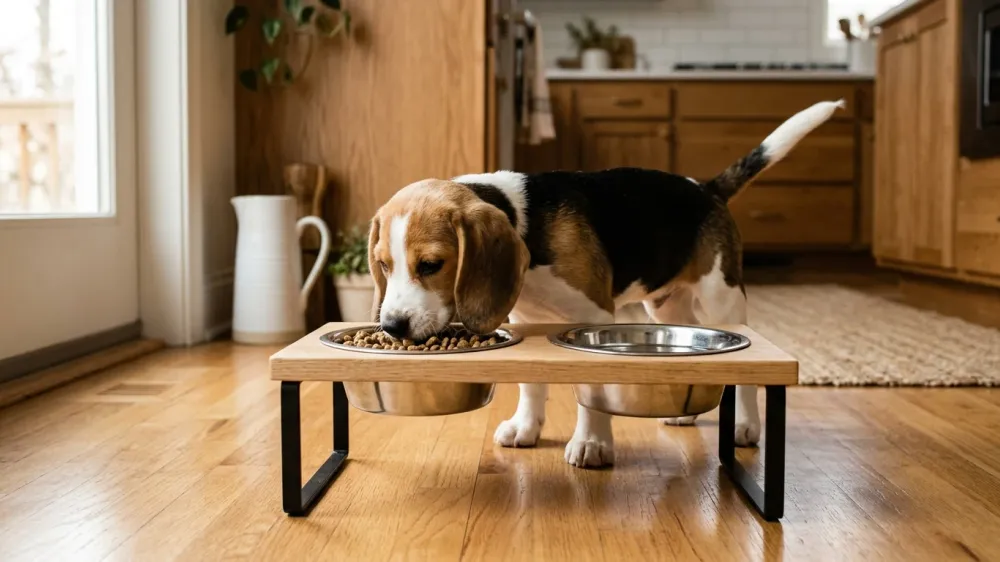
Choosing between elevated puppy bowls vs floor bowls impacts your puppy’s physical alignment, eating posture, and daily mealtime routine. Standard floor bowls remain the traditional choice for young dogs, and raised feeders can make meals more comfortable for some tall dogs. Knowing what feeding height really changes, and what it does not, helps you pick a safe setup for your home.
📋 In This Guide
Understanding Elevated Bowls vs. Floor Bowls#
Floor bowls rest directly on the ground, requiring puppies to lower their heads to floor level during meals. Elevated bowls sit inside a raised frame or stand, bringing food and water up toward the puppy’s natural chest level.
During early puppyhood, physical proportions change rapidly. A height that works for an eight-week-old retriever puppy will be entirely too low four months later. So the right choice depends on your puppy’s size today, how big they will get, and their breed’s bloat risk.
Key Benefits and Drawbacks of Standard Floor Bowls#
Standard floor bowls are universal, budget-friendly, and accessible for young pups. Because eight-week-old puppies are small, eating from floor height causes minimal neck strain during their first few weeks at home.
Pros of Floor Bowls#
- Highly accessible for toy breeds and young puppies.
- Easy to move, clean, and store.
- Zero risk of knocking down heavy frames or stands.
- Works seamlessly with standard anti-gulp inserts and meal puzzle accessories.
Drawbacks of Floor Bowls#
- Tall, fast-growing puppies have to bend a long way down to reach the bowl.
- Easier for active puppies to step into, tip over, or push across the room.
- Increases risk of messy spills and scattered kibble.
Key Benefits and Drawbacks of Elevated Bowls#
Elevated bowls raise food closer to chest height, so a tall puppy does not have to stoop as far while eating and drinking.
Pros of Elevated Bowls#
- Can be more comfortable for tall dogs and for dogs with neck or joint problems.
- Keeps feeding areas tidier by preventing puppies from kicking or stepping into bowls.
- Helps dogs with physical limitations eat without crouching.
- Keeps water off floor mats and prevents bowl-sliding.
Drawbacks of Elevated Bowls#
- Requires adjustable heights to keep pace with rapid puppy growth spurts.
- Higher initial setup cost compared to standard floor bowls.
- Requires proper sizing to avoid unnatural head positioning.
Comparing Digestion, Posture, and Joint Stress#
Posture is mostly a comfort question. A tall puppy eating off the floor does bend its neck sharply, but there is little solid evidence that bowl height changes how a healthy puppy’s joints develop. Be wary of products that promise skeletal or digestive benefits.
Bloat is the bigger concern. Bloat, or Gastric Dilatation-Volvulus (GDV), is an emergency where the stomach fills with gas and can twist. Elevated bowls do not prevent it, and raised feeders have been linked with higher risk in some large and giant deep-chested breeds. If you share your home with one of these breeds, talk to your vet before you buy a raised feeder.
Puppies that vacuum up kibble also swallow a lot of air. If your young dog gulps meals regardless of bowl height, a slow feeder is a simple fix. See our picks for the best slow feeder bowls for puppies to slow mealtimes down.
💡 Pro Tip: Measure your puppy from the floor to the lower edge of their chest. The top rim of an elevated bowl should sit approximately one to two inches below this line so your puppy can eat without stretching up.
Standard Floor Bowl vs. Elevated Bowl Comparison Table#
| Feature | Standard Floor Bowls | Elevated Bowls |
|---|---|---|
| Ideal Puppy Stage | Early puppyhood (8-16 weeks) & toy breeds | Rapid growth phase (16+ weeks) & larger breeds |
| Head Position | Bent down toward the ground | Closer to level |
| Bloat Concern | No added concern | Ask your vet first for deep-chested breeds |
| Spill Resistance | Moderate to low (bowls slide easily) | High (secured within stable frame) |
| Adjustability | Fixed height (ground level) | High (if using adjustable stands) |
| Cost | Budget-friendly | Moderate to High |
How to Choose the Right Feeding Setup for Your Puppy#
Selecting the ideal bowl depends on your puppy’s breed size, eating speed, and developmental stage.
1. Small and Toy Breeds#
Toy breeds like Chihuahuas or Miniature Poodles rarely need tall elevated feeders because floor height is already near their chest line. Simple floor bowls with non-skid rubber bottoms work exceptionally well for them.
2. Medium, Large, and Giant Breeds#
Large and giant breeds such as Great Danes, German Shepherds, and Standard Poodles are often deep-chested, which puts them in the higher bloat risk group. For these puppies, a floor bowl paired with a slow feeder is the cautious default. If your vet is comfortable with a raised feeder for your dog, choose an adjustable model so you can match the height as they grow.
3. Combining Mealtime Gear for Young Dogs#
A smooth routine for a new pup takes more than a bowl. Plan your walking gear with our best harness vs collar for puppies guide, and keep young minds busy between meals with the best interactive brain toys for puppies.
⚠️ Safety Warning: Never force a puppy to reach up above shoulder height to eat. Bowls that are set too high force the pup to extend their neck unnaturally, increasing swallow difficulty and physical neck discomfort.
Frequently Asked Questions#
Do elevated bowls prevent bloat in young puppies?#
No, elevated bowls do not prevent bloat. Raised feeders do not reduce Gastric Dilatation-Volvulus (GDV) risk and may increase it in some deep-chested large and giant breeds. People choose elevated feeders for comfort and spill control, not bloat prevention.
How high should an elevated bowl be for a growing puppy?#
An elevated bowl should sit about 1 to 2 inches below your puppy’s lower chest (sternum). When standing in front of the bowl, your puppy should be able to eat without bending their neck sharply downward or reaching upward.
Can puppies use floor bowls permanently?#
Yes, many dogs use floor bowls their entire lives without issue. Small breeds and dogs with healthy joint development do well with floor bowls. Some owners of tall breeds switch to a raised feeder for comfort later on, but for deep-chested breeds, talk to your vet first because of the bloat question.
Summary: Action Plan for Choosing Your Puppy’s Feeding Gear#
To set up your puppy’s feeding station, follow this simple plan:
- Assess Breed Size: Floor bowls suit small and toy breeds. For large or deep-chested breeds, get your vet’s view before using a raised feeder.
- Measure Chest Height: Match bowl rim height to 1-2 inches below the puppy’s lower chest.
- Control Meal Speed: Use slow feeder inserts if your puppy eats food too quickly.
- Adjust with Growth: If you use a raised feeder, check the height every few weeks during growth spurts.