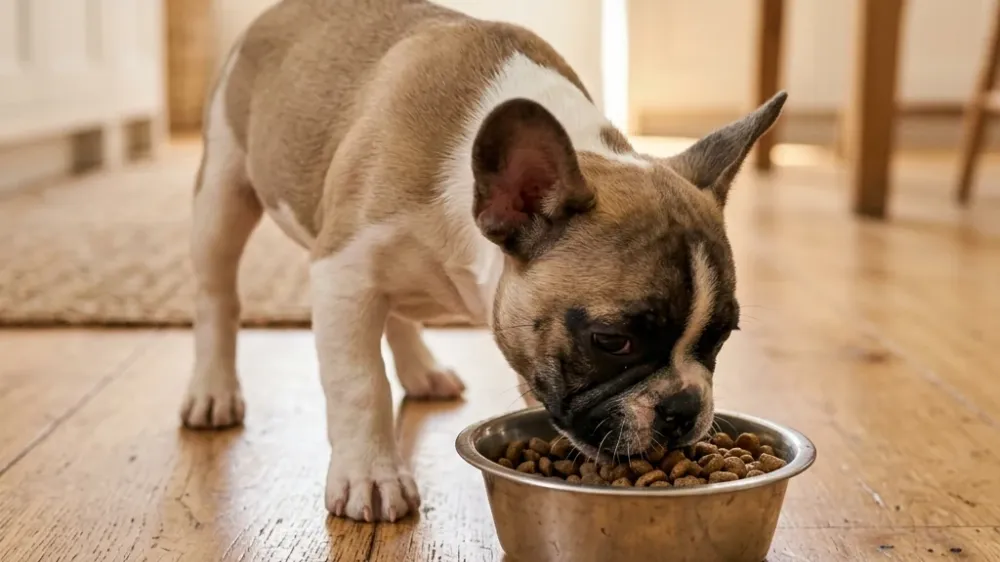
Soft stools, gas, and a one-off vomit are common in puppies. They do not tell you the food is the cause. A new bag, a stolen snack, worms, or a virus can look the same from the outside.
Sort that out before you shop for a “sensitive stomach” formula. Then pick a food that is labeled for growth, and change it over slowly.
📋 In This Guide
What an upset stomach looks like#
Merck Veterinary Manual lists the usual digestive signs: diarrhea, vomiting, a poor appetite, belly pain, and a swollen belly from gas, fluid, or food. VCA Animal Hospitals defines diarrhea as loose or unformed stool that comes more often, or in larger amounts, than usual. A little day-to-day change in stool is normal. Liquid stool that keeps going is a different matter.
Black, tarry stool can mean bleeding in the stomach or small intestine. Merck flags that color change as a reason for an exam.
When to call a vet#
VCA’s puppy diarrhea page says to go in right away if the puppy is lethargic, refuses food, is vomiting, or has blood in the stool. If the puppy is bright, eating well, not vomiting, and the stool has no blood, collect a fresh sample and take it in for a fecal test. Worms and other parasites often cause this, and you will not always see them.
Merck’s parasite table links roundworms with diarrhea, poor growth, or a pot belly, and hookworms with diarrhea and dark, tarry stool in heavy infections. The digestive-disorders chapter also lists protozoa such as Giardia, plus viruses such as parvovirus, among gut infections. VCA names diarrhea as one of the first signs of parvovirus, which can become life-threatening in a susceptible puppy.
If diarrhea lasts more than 2 days, VCA says it is time for a visit, even when the puppy still seems okay. Our puppy diarrhea guide goes through the warning signs in more detail.
⚠️ Safety Warning: Same-day vet visit if your puppy is weak, will not eat, is vomiting, or has blood in the stool. Black, tarry stool needs a visit too. Diarrhea that lasts more than 2 days needs a vet even if the puppy still seems bright. Bring a fresh stool sample.
Causes worth ruling out first#
VCA groups common causes of diarrhea this way:
- A diet change, or a food the dog does not tolerate
- Dietary indiscretion: trash, or other irritating stuff the puppy ate
- Infection with bacteria, viruses, coccidia, or worms
- Stress after travel, boarding, or another change in routine
VCA’s puppy page adds the everyday version of indiscretion: trash, sticks, bird droppings, and other dogs’ stool.
Tufts Petfoodology separates a food allergy from an intolerance. An allergy is an immune reaction to a protein, and it can show up as itchy skin, ear trouble, vomiting, or diarrhea. An intolerance means the recipe does not suit that dog: too much fat, too much fiber, too little fiber, or some other property. Food allergy is real. For chronic diarrhea, Tufts calls it the least likely of the diet explanations. Parasites, infections, and other diseases come up more often.
When a food allergy is confirmed, the ingredients reported most often in dogs are chicken, beef, dairy, and egg. Grains are uncommon triggers. A dog can still be allergic to a specific grain. That is just less common than an allergy to an animal protein.
Merck notes a separate milk issue: in rare cases, newborn pups get diarrhea while they are on milk because they cannot digest lactose. That is a narrow finding about newborns. It does not mean every weaned puppy reacts to dairy ingredients in kibble.
What the diet can change#
There is no single diet that helps every dog with ongoing diarrhea. Tufts describes three approaches, tried one at a time:
- A highly digestible food, sometimes with less fat. Some dogs with chronic diarrhea do better this way. How far to lower the fat varies by dog. A growing puppy still needs a food labeled for growth, so an adult low-fat food is a vet decision, not a bag you grab on your own.
- More fiber. Dogs with colitis often respond to a higher-fiber food, and some dogs with other chronic diarrhea do too. The guaranteed analysis does not tell you the fiber type. A vet picks the food or the fiber plan.
- An elimination diet, if a food allergy is still in question. That trial uses a veterinary novel-ingredient diet, a hydrolyzed diet, or an elemental diet. Even if stools improve, the change may be the fat level or the digestibility, rather than an allergy.
AAHA’s 2021 nutrition and weight management guidelines put the same idea in shorter form: soft stool or diarrhea can often be managed by changing ingredients, fat, or fiber.
Limited ingredient, novel protein, hydrolyzed protein#
“Limited ingredient” on a pet-store bag is a marketing line, not a test result. Tufts says many of those diets contain more ingredients than the name suggests, and studies have found common proteins that were not on the label. For a food trial, Tufts recommends a veterinary diet. Very few novel-ingredient or hydrolyzed diets meet the needs of growing puppies, so the vet has to confirm the food still fits growth.
A novel protein is one your puppy has never eaten. It is not gentler by nature. What is new for one puppy is ordinary for another. Lamb, duck, and salmon can be the problem if they are already in the diet history. Carbohydrates count too, because rice, corn, peas, and potatoes contain protein.
A hydrolyzed diet uses proteins broken into pieces small enough that the immune system is less likely to recognize them. Those diets come through a clinic. A salmon-and-rice puppy food from a store is a different product.
Tufts says digestive elimination trials are often planned for 3 to 4 weeks, and skin trials for at least 8 to 12 weeks. The chronic-diarrhea page describes an 8 to 12 week trial for that problem. Your vet sets the length. During a trial, treats, chews, table food, and other flavored extras have to stop, or the trial does not count.
Fiber, probiotics, and fat#
VCA says some gastrointestinal diets use a balance of fibers that feed gut bacteria. A prebiotic is that kind of fiber. It is food for the bacteria. It is not a live probiotic.
VCA also says some probiotic products may help dogs with diarrhea, and that quality and effect are not always known. AAHA says quality control and results vary among supplements, so check with your vet before you add one. This page does not give a dose.
Puppy foods are calorie-dense because puppies are growing. Tufts notes that dog-food fat levels vary widely, and that a lower-fat, highly digestible diet helps some dogs with chronic diarrhea. The right level is individual. The food still has to be appropriate for growth.
Grains#
WSAVA’s nutrition FAQ says cooked cereal grains are not fillers. Dogs digest them when they are cooked, and they supply energy, fatty acids, vitamins, minerals, and fiber. The ingredient list does not, by itself, prove how digestible a food is. The useful line on the bag is the AAFCO statement, which says whether the food is complete for a life stage.
| Approach | What it changes | When a vet may use it |
|---|---|---|
| Highly digestible, sometimes lower fat | Easier meals, with the fat level set for that dog | Some ongoing diarrhea. A puppy still needs a growth food. |
| Higher fiber | More fiber, type chosen by the vet | Often colitis, and some other chronic diarrhea |
| Veterinary elimination diet | A new protein, or protein in small pieces, plus no other flavored foods | A food-allergy trial. This is the less common path. |
| Grain-free | Grains replaced with other starches | A diagnosed grain problem, which is uncommon |
Grain-free food and DCM#
Since July 2018, the FDA has looked into reports of dilated cardiomyopathy (DCM), a disease where the heart muscle becomes enlarged and struggles to pump, in dogs eating diets with peas, lentils, or other pulses high on the ingredient list. Many of these foods were grain free, but some contained grains. The FDA has not shown that these diets cause DCM and has not asked for them to be recalled. In December 2022 it said it would share more only when there is meaningful new science.
Our grain-free vs grain-inclusive puppy food page stays with that FDA wording. A grain-free bag is not a treatment for soft stool.
A puppy formula you can check on the label#
Purina still sells Pro Plan Puppy Sensitive Skin & Stomach Salmon & Rice Formula. These points come from that page and from Purina’s label file.
- Salmon is the first ingredient.
- Purina says the food is gentle on the stomach, helps maintain stool quality, and includes rice because rice is easy to digest.
- The ingredient list also includes barley, fish meal, canola meal, beef fat, dried yeast, oat meal, pea protein, salmon meal, fish oil, sunflower oil, and dried chicory root.
- Purina says the natural prebiotic fiber nourishes intestinal bacteria. The ingredient list does not name a live probiotic.
- Fish oil is a source of EPA and DHA. Purina says DHA from fish oil supports brain and vision development.
- The guaranteed analysis lists a minimum of 28% crude protein, a minimum of 18% crude fat, and a maximum of 3% crude fiber. That is a growth recipe, not a low-fat or high-fiber therapeutic diet.
- The AAFCO line says the food is formulated to meet the AAFCO Dog Food Nutrient Profiles for all life stages, including growth of large sized dogs (70 lb. or more as an adult).
- Pea protein sits on the list before the vitamin and mineral block. The FDA question above is about peas and other pulses, so ask your vet if that ingredient matters for your puppy.
- The label’s feeding table is the portion guide. Purina says those amounts are a starting point, and that avoiding overfeeding supports development, especially in large breeds.
WSAVA’s point still applies: an AAFCO growth statement tells you the food is complete for a puppy. The ingredient story does not replace that line.
Large-breed puppies also need slow, lean growth. If your puppy will be a big adult, use the Golden Retriever puppy food guide alongside the label check above.
Purina Pro Plan Puppy Sensitive Skin & Stomach Salmon & Rice Formula
Salmon is the first ingredient. Purina says the rice is easy to digest and the prebiotic fiber supports digestion. The label meets AAFCO profiles for all life stages, including growth of large dogs. It is not a hydrolyzed or single-protein diet.
| Pros | Cons |
|---|---|
| Salmon is first, and the AAFCO line includes all life stages plus large-size growth. | Fish meal, beef fat, and pea protein are also on the list, so this is not a single-protein or hydrolyzed diet. |
| Purina says rice and prebiotic fiber support stool quality and gut bacteria. | At least 18% crude fat and at most 3% crude fiber: not a low-fat or high-fiber therapeutic food. |
| The formula is still on Purina’s site, with a feeding table. | No live probiotic is named on the ingredient list. |
💡 Pro Tip: Feed the amount on the bag, then adjust with your vet if your puppy is getting heavy or staying thin. WSAVA says treats should stay at or under about 10% of the day’s calories. During a switch, a few pieces of the measured kibble can stand in for extra snacks.
How to switch foods#
WSAVA says a healthy pet should change food over at least 3 days, and longer if the pet is ill. A sudden swap can cause vomiting and diarrhea. The FAQ example mixes the foods in one bowl:
- Day 1: 75% current food, 25% new food.
- Day 2: half and half.
- Day 3: 25% current food, 75% new food.
- Day 4: all new food.
For this Pro Plan formula, Purina asks for 7 to 10 days: a little less of the old food and a little more of the new food each day. If the stomach is already off, use that longer window.
VCA uses 7 to 14 days when a puppy moves from puppy food to adult food. Watch this switch the same way: if stools loosen, the puppy vomits, or appetite drops, slow the change down. If that is not settling within 24 hours, call your vet.
Keep meals on a clock. A puppy feeding schedule by age shows how many meals fit each stage. Portions still come from the bag. When growth is finished, change foods just as slowly. When to switch a puppy to adult food covers timing by adult size.
Frequent loose stool also makes house training harder. A set potty routine is easier to keep once stools are predictable.
Questions owners ask#
How soon should stools look normal?#
There is no day count that fits every puppy. VCA says diarrhea that lasts more than 2 days needs a vet. Waiting weeks to “see if the new bag works” leaves parasites, infection, and other causes unchecked.
Is grain-free better for a sensitive stomach?#
Most puppies do well on a complete, grain-inclusive food labeled for growth. Tufts reports that grains are uncommon food allergens, and that chicken, beef, dairy, and egg account for more of the confirmed cases. The FDA heart investigation is a separate reason to talk with your vet before you choose a diet with peas, lentils, or other pulses high on the ingredient list.
Can stress upset a puppy’s stomach?#
Yes. VCA lists stress, especially after travel, boarding, or another change in the environment, as a cause of diarrhea. The food can be unchanged and the stool can still go soft.
Does a limited-ingredient bag prove a food allergy?#
A food allergy is diagnosed with an elimination trial your vet sets up. Tufts describes a veterinary novel, hydrolyzed, or elemental diet, with no other flavored foods, often for 3 to 4 weeks when the signs are digestive and 8 to 12 weeks when the skin is involved. Over-the-counter limited-ingredient foods are a weak stand-in because of extra ingredients and cross-contact. Very few of the trial diets are made for growing puppies.
What to do this week#
- If the puppy is weak, not eating, vomiting, or passing blood, call a vet now. Bring a fresh stool sample either way.
- Ask the clinic before you change food. VCA says a short-term veterinary gastrointestinal diet is the usual plan for diarrhea, and that chicken and rice is no longer the recommendation in most cases.
- If you and your vet pick an everyday puppy food, read the AAFCO line. It should say growth. If the adult weight will be 70 lb or more, it should include growth of large sized dogs.
- Switch over 7 to 10 days. Slow down if the stool softens, and call the vet if that does not settle within a day.
- Feed the amount on the bag. Skip table scraps while you are judging the new food.